The global hair extension market is projected to reach approximately USD 3.05 billion in 2026, growing at a compounded annual rate of 7.74% toward USD 5.54 billion by 2034. Within that expanding category, a quiet specification shift is underway: searches for “weft hair extensions” overtook “hand-tied extensions” in US query data for the first time in 2026, and salon-installed methods now account for 74% of extension revenue, up from 63% six years ago. At the center of this demand sits a processing standard that professional stylists increasingly treat as a baseline rather than a luxury: double drawn weft hair extensions.
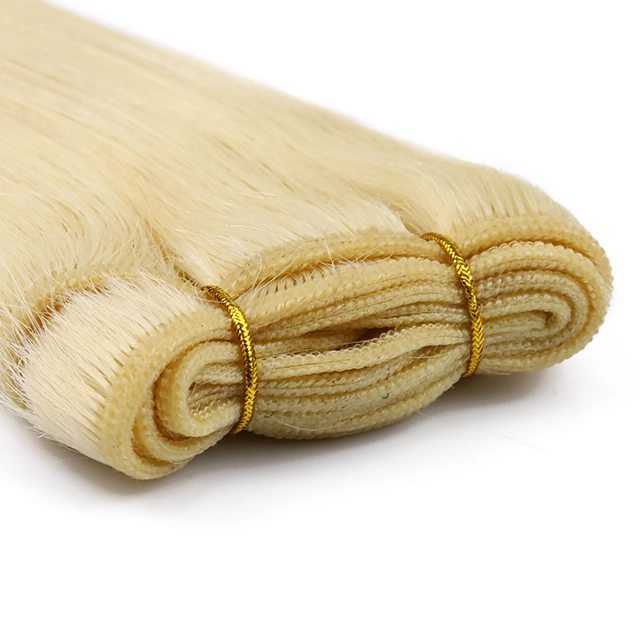
This image shows the roots of golden weft hair extensions.
Part I: What Double Drawn Weft Hair Extensions Actually Are
Double drawn weft hair extensions are weft-format extensions made from human hair that has been sorted twice to remove short strands, so that the majority of hairs in the bundle reach, or come very close to, the stated length. In a standard single drawn bundle, only 50–65% of strands reach full length, with the remainder tapering naturally toward the tips. In a double drawn bundle, that proportion rises to 70–80%, producing what the trade describes as a “blunt” or “full” end rather than a tapered one.
The weft itself is the strip of hair sewn or bonded along the top; it is the format most associated with sew-in, micro-ring, and braided installations. When the double drawn specification is applied to a weft, the result is a track that carries consistent density from the attachment line to the tip, rather than thinning out in the final inches. As one supplier puts it, the double drawn process means “all shorter hair strands are removed, and only full-bodied hair makes up the hair weight”. Crucially, “double drawn” describes the sorting method, not the donor status or chemical history of the hair; a bundle can be virgin double drawn or processed double drawn, and buyers should confirm both attributes separately.
Part II: Characteristics and Advantages, by Specification and Design
The advantages of double drawn weft hair extensions are not abstract claims. They follow directly from measurable differences in strand distribution, bundle weight, and weft construction. The table below organizes the most consequential specifications against the concrete benefit each delivers.
Specification / Design
What It Means in Practice
Corresponding Advantage
70–80% full-length strands (vs 50–65% in single drawn)
The majority of hairs reach the stated length rather than tapering off
Full, blunt ends that do not thin out in the final inches; a polished, uniform finish through the length
Higher gram weight per bundle at the same length
Fewer short strands have been removed, so the bundle is denser
More hair per track; fewer tracks may be needed to achieve a target volume, which can reduce installation time and attachment-point load
Consistent root-to-tip density
Thickness does not drop measurably between the weft line and the tip
Styles that depend on an even hemline—sleek straight looks, blunt cuts, layered “curtain” fringes—hold their shape without the wispy ends that betray single drawn hair
Genius / flat / seamless weft construction (0.5–1.5 mm seam)
The weft is finished flat rather than folded into a bulky band
The double drawn density is delivered on a seam thin enough to sit undetectably against the scalp, even on fine hair; many genius wefts can be cut anywhere without re-sewing
This image shows us weft hair extension products.
Part III: Where Double Drawn Weft Hair Extensions Fit Best
The Fine-to-Medium Density Client Seeking Visible Fullness
For clients with naturally fine or thin hair who want a noticeable increase in volume rather than merely length, double drawn wefts are the specification most likely to meet the brief. The full ends prevent the extension from “disappearing” against already-wispy natural tips, and the higher strand count per track means the density gain is visible from the first row.
Bridal, Event, and Camera-Facing Styling
Weddings, editorial work, and red-carpet styling place a premium on hemlines that photograph as solid and intentional. The blunt, full finish of double drawn weft hair extensions eliminates the translucent tips that can read as thinning on camera, and the format’s compatibility with curling, straightening, and precision cutting allows stylists to build the shape around the density rather than fighting it.
Long-Term Wear and Salon Re-Application Cycles
Wefts installed via micro-ring or braided methods typically require re-application every four to six weeks, and the hair itself may be reused across multiple install cycles. A double drawn weft’s density is less vulnerable to the cumulative thinning that affects tapered bundles over repeated washing and styling; the full ends remain full, which extends the period before the extension reads as “tired”.
The Blunt-Cut and “Glass Hair” Aesthetic
The current demand cycle for sleek, mirror-finish blowouts and one-length cuts depends on ends that behave like a solid sheet rather than a series of diminishing strands. Double drawn wefts are the only weft specification that reliably delivers that behavior without requiring the stylist to over-layer the perimeter to create the illusion of fullness.
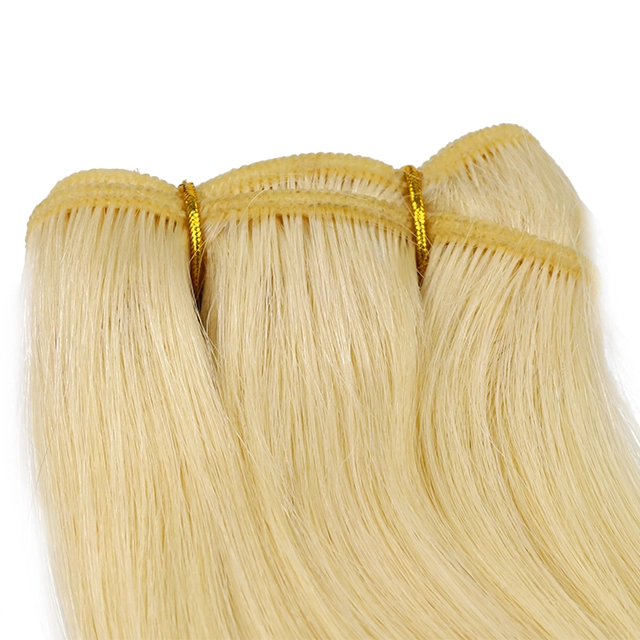
This image shows the roots of weft hair extensions. The ends are very thick, indicating "double-drawn" hair quality.
Part IV: Critical Considerations Before Specifying Double Drawn Wefts
It Is Not Automatically the Right Choice for Every Head
Double drawn wefts carry more hair per track and cost more per bundle than single drawn equivalents. For a client with extremely fine, fragile natural hair whose primary goal is a soft, undetectable blend, the density of a double drawn weft can actually overwhelm the natural hair, creating a visible disconnect at the blend point. In those cases, a single drawn or lighter-weight weft may produce a more seamless result. Double drawn weft hair extensions are a density tool, not a universal upgrade.
The Specification Must Be Verified, Not Assumed
The term “double drawn” is not uniformly regulated across the supply chain. The practical verification method is the root-to-tip pinch test: hold the bundle at the weft and pinch toward the tips; genuine double drawn hair feels nearly as thick at the ends as at the root. Buyers should also request the gram weight at the stated length—a true double drawn 22-inch bundle will weigh noticeably more than a single drawn bundle of the same length because fewer short strands have been removed.
Weft Design Matters as Much as the Draw
A double drawn specification on a bulky machine-weft seam can undermine the advantage by making the track difficult to conceal. The most current professional formats pair double drawn hair with genius, flat, or seamless constructions in the 0.5–1.5 mm range, which preserve the density while keeping the attachment profile low. Specifying “double drawn” without specifying weft design is an incomplete brief.
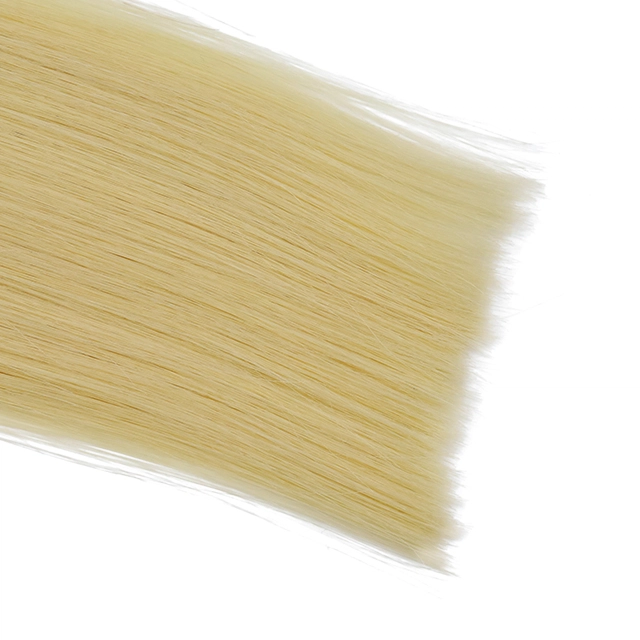
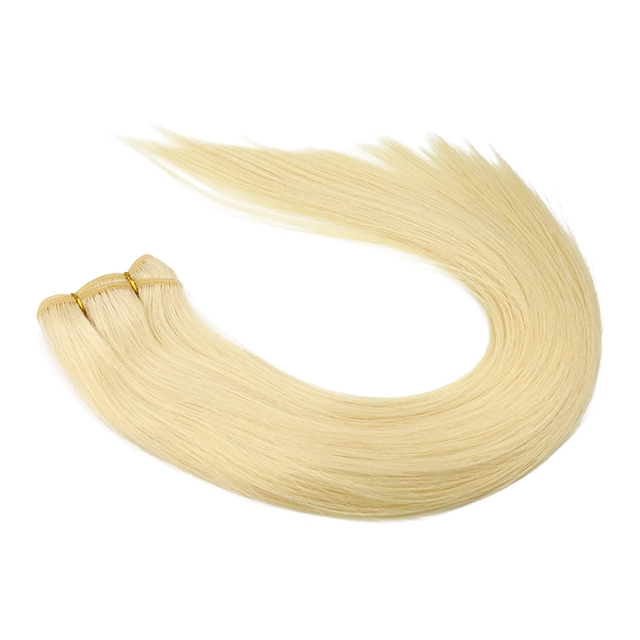
This image showcases the quality of the blonde weft hair extensions, featuring a “double drawn” construction.
Conclusion
Double drawn weft hair extensions occupy a specific and increasingly central position in the professional extension market: they are the format of choice when the goal is measurable, visible fullness through the ends, delivered on a track that modern flat-weft engineering can make genuinely concealable. The data supports the demand shift—wefts are gaining search and revenue share, and salon-installed methods dominate the professional landscape. But the specification rewards informed buying. The stylist or buyer who understands the 70–80% full-length threshold, verifies bundle weight, and pairs the draw with a thin-profile weft will get exactly what the category promises: density that holds its shape from the weft line to the tip. Those who treat “double drawn” as a marketing label rather than a measurable specification will not.
Dont hesitate to Contact EMEDA Hair Factory: WhatsApp: +8618562611116 Email: sales02@emedahair.com

 WhatsApp: +8618562611116