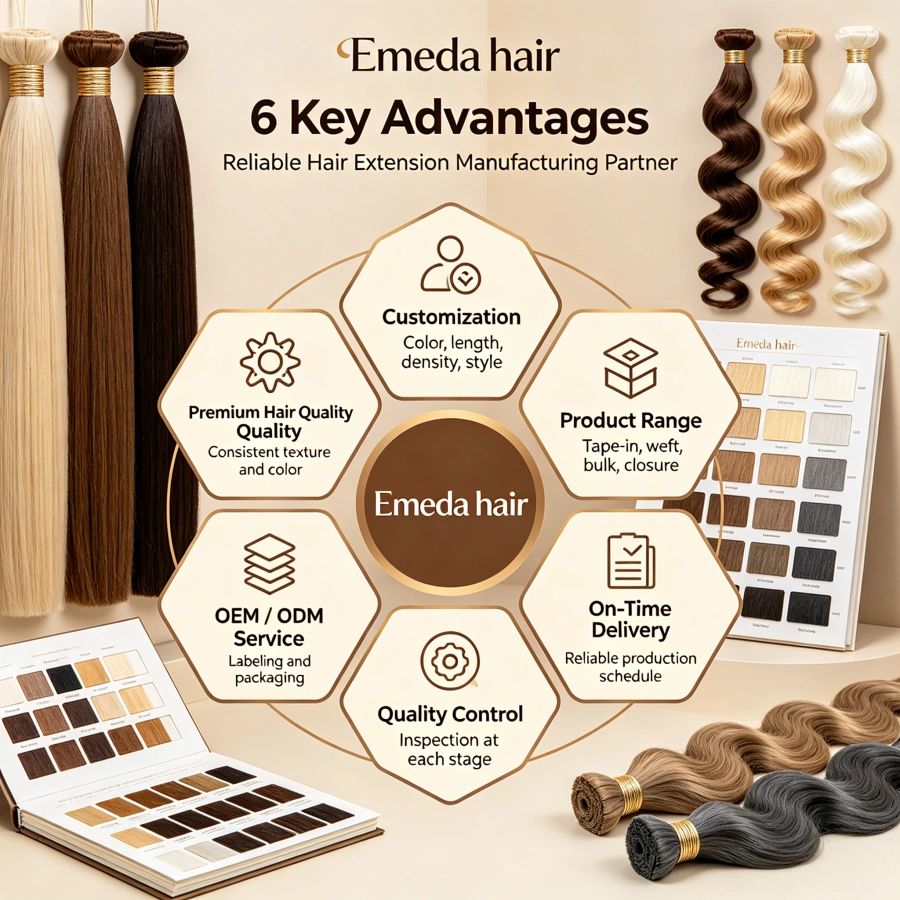

Choosing a reliable hair extension supplier is one of the most important decisions for a professional hair salon. The quality of hair extensions affects more than the final hairstyle. It also influences installation efficiency, customer satisfaction, maintenance requirements, repeat bookings, and the salon’s long-term profitability.
However, finding a trustworthy supplier is not always easy. Hundreds of hair extension manufacturers, wholesale distributors, and private label suppliers offer different hair qualities, product specifications, and prices.
Some suppliers offer attractive prices but cannot maintain consistent quality between orders. Others provide excellent samples but have limited inventory, slow production, or unclear after-sales policies.
So, how do salons choose a reliable hair extension supplier?
The best approach is to evaluate the supplier through a structured purchasing process. You need to understand the hair material, compare different extension methods, test product samples, verify color consistency, examine quality control, and confirm the supplier’s ability to fulfill repeat orders.
This guide explains ten essential factors salon owners and professional hairstylists should consider before selecting a long-term hair extension supplier. It also includes a practical supplier evaluation checklist to help you make more informed purchasing decisions.
Before contacting manufacturers or wholesalers, understand exactly what your salon needs.
Different salons have different customer groups, service menus, and pricing strategies. A salon specializing in premium hair transformations may require high-end human hair extensions, while a salon focusing on everyday styling may prioritize versatile products and competitive purchasing costs.
Choosing products without understanding your service requirements can lead to excessive inventory, unsuitable products, and unnecessary purchasing expenses.
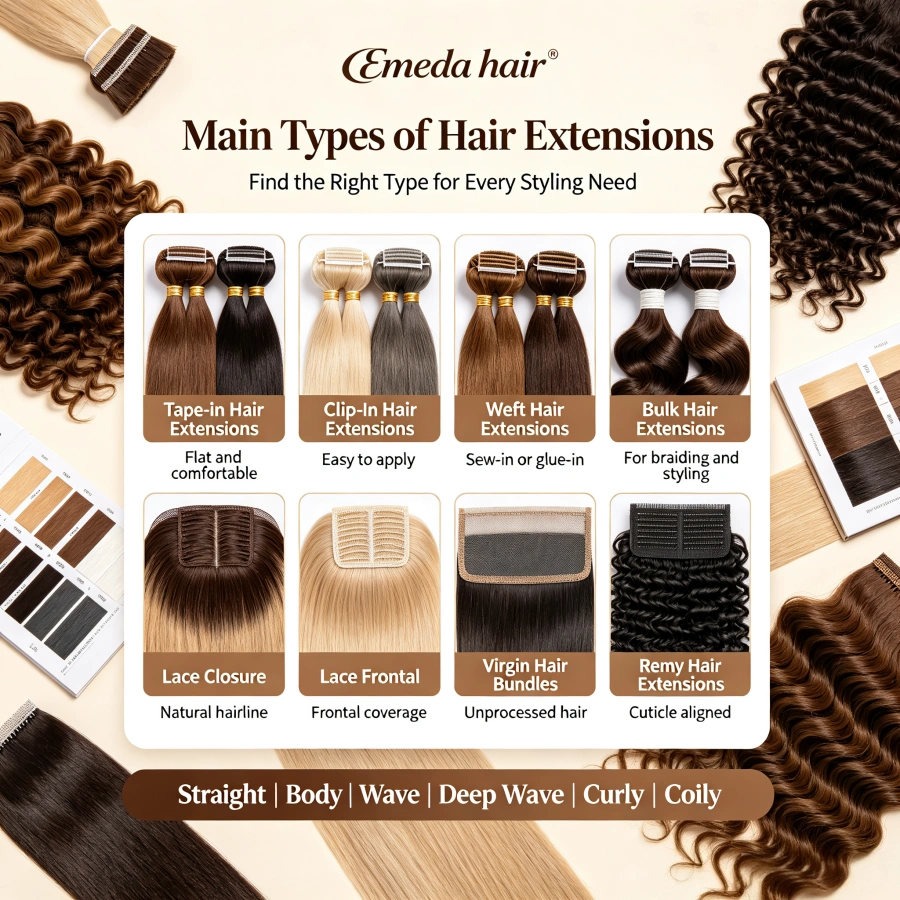
Weft Hair Extensions
Weft extensions consist of hair strands attached to a continuous track. They are commonly used in professional installations, including sew-in and other compatible row-based methods.
Different constructions include machine wefts, hand-tied wefts, and Genius wefts.
Tape-In Hair Extensions
Tape-in extensions use adhesive tabs to attach extension hair to sections of natural hair.
They are popular among salons offering semi-permanent extension services. Buyers should pay attention to tape dimensions, adhesive consistency, hair density, and removal requirements.
Keratin Tip Hair Extensions
Keratin tip extensions are individual strands with pre-bonded attachment tips. They are installed using an appropriate professional bonding technique.
Consistent bond size, tip construction, and hair distribution are important quality factors.
Nano Ring and Micro Ring Extensions
These products use small attachment points and compatible rings to secure individual extension strands.
Salons should examine tip construction, ring compatibility, strand weight, and product consistency.
Clip-In Hair Extensions
Clip-in extensions are designed for temporary styling and can be installed and removed without a permanent attachment method.
Important considerations include clip strength, stitching quality, hair distribution, and finished set weight.
| Product Type | Common Salon Application | Main Purchasing Consideration |
|---|---|---|
| Machine Weft | Professional row installations | Track strength and density |
| Hand-Tied Weft | Hand-tied row installations | Thin, flexible construction |
| Genius Weft | Professional weft installations | Seam thickness and flexibility |
| Tape-In | Tape-based applications | Adhesive and tab quality |
| Keratin Tip | Individual strand applications | Bond consistency |
| Nano Ring | Individual strand applications | Tip and ring compatibility |
| Clip-In | Temporary styling | Clip strength and set construction |
A professional supplier should offer products that match your salon’s actual service requirements.
For salons comparing multiple extension methods, explore the Emeda wholesale hair extension collection to review the available product categories.
The second step is to understand who actually produces the products you intend to purchase.
Many companies use terms such as manufacturer, factory, wholesale supplier, and direct supplier interchangeably. However, these business models can involve different responsibilities.
A manufacturer controls some or all of the production process.
Potential advantages include:
However, buying directly from a factory does not automatically guarantee good quality. The final product and quality control process still need to be evaluated.
A distributor purchases products from manufacturers and resells them to salons, retailers, and other businesses.
Distributors may offer convenient advantages, such as ready stock, smaller order quantities, and faster domestic fulfillment.
A trading company connects buyers with different manufacturers and sourcing channels.
It may offer broader product selections and international purchasing support.
The important question is whether the company can clearly explain who manufactures your product, who checks its quality, and who is responsible when an order does not match the approved specifications.
Before placing an order, request:
For example, Emeda Hair’s company introduction identifies Qingdao Emeda Arts & Crafts Co., Ltd. as a human hair products business established in the international market in 2013 and describes its production cooperation facility and business support team.
When evaluating any supplier, distinguish between an owned factory, a cooperative factory, and outsourced production. These arrangements differ and should be clearly understood before entering a long-term purchasing agreement.
Hair quality is one of the most important considerations when choosing a hair extension supplier.
You will often encounter marketing descriptions such as 100% Virgin Hair, Remy Hair, Single Donor Hair, Premium Human Hair, and Double Drawn Hair.
However, these terms describe different characteristics. They should not be treated as interchangeable quality grades.
Remy hair generally refers to human hair collected and processed with the cuticles maintained in a consistent root-to-tip direction.
Maintaining cuticle alignment can help reduce friction between neighboring strands.
However, Remy hair does not automatically mean that the hair is completely unprocessed, comes from one donor, or maintains the same density throughout its length.
Virgin hair generally refers to human hair that has not undergone chemical processing such as bleaching, dyeing, or permanent texture alteration.
However, terminology and verification practices vary between suppliers.
Ask the manufacturer to explain exactly what it means by Virgin Hair and how that claim is supported.
These descriptions refer to the distribution of hair lengths within a product.
| Feature | Single Drawn Hair | Double Drawn Hair |
|---|---|---|
| Length distribution | Greater variation in strand lengths | Higher proportion of strands near the specified length |
| End appearance | Usually more tapered | Usually fuller |
| Overall look | More graduated | More uniform |
| Common application | Natural volume and blending | Fuller-looking hairstyles |
Neither is automatically the best choice for every client.
A salon should choose based on customer preferences, installation requirements, service prices, and the expected finished appearance.
Do not rely exclusively on supplier-created grading systems such as 8A, 10A, or 12A. There is no universally enforced grading scale that makes these labels directly comparable between manufacturers.
It is better to evaluate measurable specifications and actual sample performance.
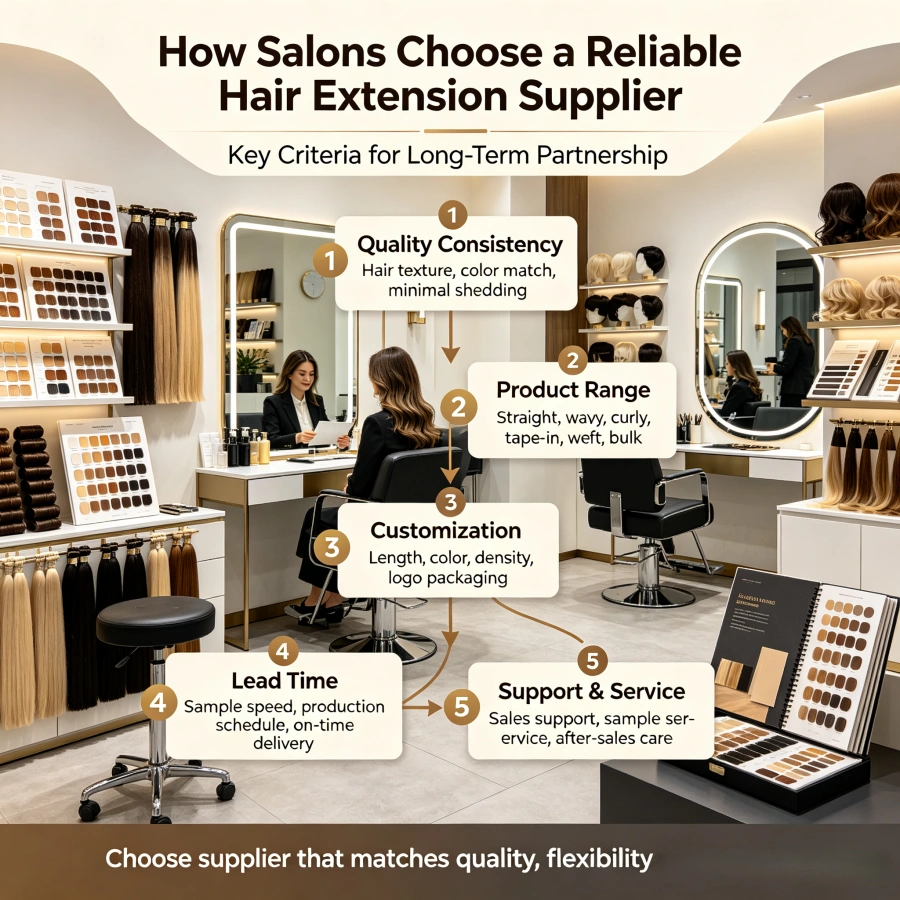
A supplier may provide excellent products but still be unsuitable for your salon if its product range does not match your business model.
A professional supplier should understand the requirements of different extension methods.
Machine wefts are produced using sewing machinery to attach hair strands to a continuous track.
They are commonly used in professional row-based extension applications.
When purchasing, check track thickness, stitching consistency, hair density, loose strands, and edge finishing.
Explore Emeda Machine Weft Hair Extensions for its available product selection.
Hand-tied wefts are constructed by manually tying or securing hair strands into a thin track.
They are used in specific professional row-installation systems.
Buyers should evaluate track flexibility, seam construction, and product handling.
View Emeda Hand-Tied Hair Extensions for more information.
Genius wefts are designed with a specialized thin-track construction.
They are commonly selected by professional stylists looking for a low-profile weft option.
However, construction details can vary between suppliers. Ask for product samples and confirm the actual seam thickness and flexibility.
You can review Emeda Genius Weft Hair Extensions when comparing weft products.
Tape-in products should be evaluated according to the adhesive system, tab size, hair quality, and installation requirements.
Explore Emeda Tape-In Hair Extensions for available options.
Clip-in products are useful for salons serving temporary styling needs, while nano extensions are designed for individual strand installation.
A supplier offering multiple product types may help salons develop a more complete product range.
Emeda also provides Clip-In Hair Extensions and Nano Hair Extensions.
Before expanding your product menu, ensure that your stylists have the necessary training and installation experience for each method.
Never choose a hair extension supplier based only on website photographs or promotional descriptions.
A product may look smooth and shiny when first unpacked but behave differently after washing, drying, detangling, and styling.
A practical sample-testing process should include three stages.
When receiving a sample, check:
Compare the sample against the supplier’s written specifications.
Ask an experienced stylist to test the product using its intended professional installation method.
Depending on the product, evaluate:
Follow the manufacturer’s care recommendations during testing.
Do not use aggressive chemical treatments unless the supplier confirms that the product is suitable.
The first sample is only the beginning.
Once the sample is approved, place a controlled trial order and compare the received products against the original reference.
Record any differences in:
This is particularly important for salons that plan to purchase the same products regularly.
A reliable hair supplier should be able to reproduce an approved product specification, not simply send one impressive sample.
Color matching is one of the most important factors in professional hair extension services.
A slight shade difference can affect blending, especially when working with blonde, highlighted, balayage, or rooted hair.
A physical color ring is more practical than selecting colors from website photos.
It allows stylists to compare extension shades with clients’ natural hair under different lighting conditions.
A professional color system should include:
For salons with regular clients, matching replacement products is particularly important.
A useful color management process includes:
Consider a salon that frequently installs the same blonde shade.
If the next shipment has a noticeably different undertone, the stylist may need additional blending work or another product to complete the service.
This can increase installation time and reduce service profitability.
The best suppliers should provide consistent color references and communicate clearly when a product specification or production process changes.
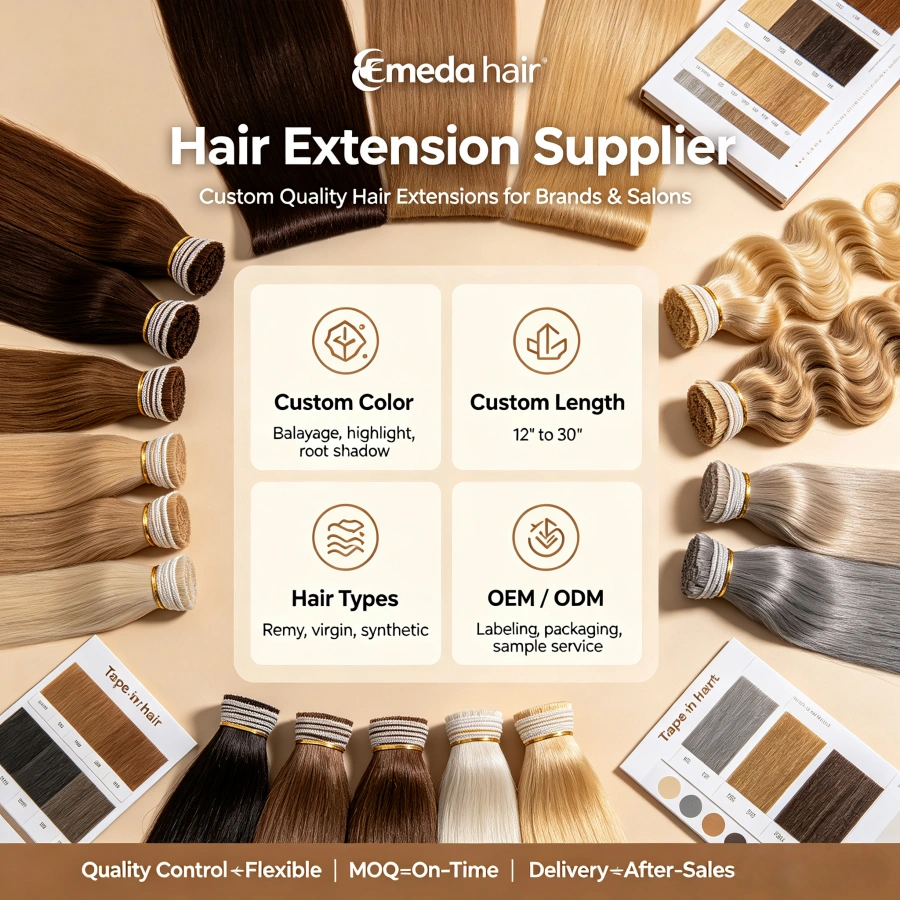
Two hair extension products may carry the same advertised length but have different usable hair quantities and finished appearances.
Always confirm the following specifications.
Ask how the supplier measures hair length.
Straight extensions are generally easier to measure directly, while wavy and curly extensions may have different measurements when stretched and unstretched.
Make sure the supplier uses a clearly defined measurement method.
Confirm whether the listed weight refers to the actual hair or includes packaging, clips, tape, or other accessories.
For example, a product advertised as 100g should specify whether this means 100g of hair or 100g of finished packaged goods.
End density influences the final appearance of installed extensions.
A product with more uniform strand lengths can appear fuller through the ends than one with a greater proportion of shorter strands.
For salons offering premium services, end fullness should be part of the purchasing specification.
The structure also matters.
Weft products should be checked for seam consistency, while tape-in extensions require attention to adhesive distribution and tab dimensions.
Keratin tip products should be checked for bond shape and consistency.
For a more detailed understanding of product construction, read Emeda’s guide to What Are Weft Hair Extensions?.
Price is an important consideration, but the cheapest supplier is not necessarily the most profitable choice.
Different quotations may refer to different hair qualities, lengths, weights, processing methods, and packaging configurations.
Before comparing suppliers, make sure you are comparing equivalent products.
Several factors influence the final quotation:
| Cost Factor | How It Affects the Price |
|---|---|
| Hair material | Different materials and quality specifications have different costs |
| Hair length | Longer hair generally requires different raw material inputs |
| Weight | More hair per package increases material consumption |
| Drawing level | Fuller end density can require additional selection |
| Texture | Straight, wavy, and curly products may require different processing |
| Product construction | Weft, tape, and pre-bonded products have different manufacturing requirements |
| Packaging | Customized boxes and labels may add costs |
| Order quantity | Larger orders may qualify for different pricing |
Ask whether the MOQ applies to each:
A supplier may accept a flexible total order quantity but require a minimum quantity for specific custom colors or packaging.
A useful purchasing formula is:
Total Landed Cost = Product Cost + Packaging Cost + Customization Cost + Freight + Applicable Import Charges
Also consider the cost of inventory storage, potential replacements, and quality-related rework.
Salon owners should understand the relationship between product cost and service revenue.
Service Contribution = Service Revenue – Hair Material Cost – Direct Consumables – Direct Service Labor
For example, a cheaper extension product may require more styling time or create additional correction work.
A product with a higher purchase price may offer better business value when its specifications and performance are more consistent.
The supplier’s service capability becomes particularly important once your salon begins receiving regular orders.
A reliable supplier should communicate clearly about stock availability, production scheduling, and shipping arrangements.
Before purchasing, ask:
Request written information about:
A supplier should have a clear process for investigating product issues.
Do not rely entirely on verbal assurances when placing large wholesale orders.
For established salons and beauty entrepreneurs, creating a private label hair extension collection can help establish a distinct market position.
Instead of selling standard products under another brand, you can develop a collection with your own logo, colors, and product specifications.
Depending on the product and manufacturing capability, customization may include:
A professional customization process should include clear communication about samples, artwork, MOQ, production time, and final approval.
Step 1: Define Your Product Positioning
Decide whether your target market focuses on premium salon services, affordable extensions, or specialized professional techniques.
Step 2: Select Product Specifications
Confirm hair type, length, texture, colors, weight, and attachment method.
Step 3: Develop Packaging
Provide your logo and packaging design requirements.
Step 4: Approve Samples
Check the finished product and packaging before mass production.
Step 5: Confirm Commercial Terms
Agree on quantity, pricing, lead time, shipping, and quality requirements.
Emeda provides a customized hair products service covering different hair product requirements and personalized solutions.
For a salon developing a new product collection, it is important to confirm that the supplier can reproduce the approved specifications across future orders.
After collecting samples and quotations, organize your findings in a standardized evaluation table.
This reduces the risk of choosing a supplier based only on price or sales communication.
| Evaluation Category | Suggested Weight | What to Check |
|---|---|---|
| Hair Quality | 20 | Material, processing, and sample performance |
| Product Construction | 15 | Weft, tape, bond, or clip quality |
| Sample Testing | 15 | Installation and maintenance performance |
| Color Consistency | 15 | Shade matching and repeatability |
| Quality Control | 10 | Inspection and batch records |
| Delivery Reliability | 10 | Stock, production, and shipment |
| Commercial Terms | 5 | MOQ and payment conditions |
| After-Sales Support | 10 | Defect handling and communication |
| Total | 100 |
The suggested scoring system is an internal purchasing tool, not an industry certification.
| Score | Suggested Decision |
|---|---|
| 85–100 | Strong candidate for long-term cooperation |
| 70–84 | Further sampling or negotiation recommended |
| Below 70 | Investigate major weaknesses before ordering |
Do not let a high overall score hide a critical problem.
For example, unclear human hair composition, incorrect product specifications, or unacceptable commercial terms should be treated as reasons to pause purchasing.
Recognizing supplier warning signs can prevent unnecessary business risks.
If a supplier offers a much lower price than competitors, ask what is different about the material, weight, length, and construction.
A professional supplier should be willing to discuss samples and provide clear product specifications.
Be careful when suppliers use Remy, Virgin, Single Donor, and Double Drawn interchangeably.
Ask them to explain the actual product characteristics.
Request current photographs and videos showing the actual products rather than relying entirely on generic promotional images.
A supplier should be willing to explain how it handles incorrect specifications, damaged goods, and verified product defects.
Confirm whether the supplier manufactures the products, uses a cooperative factory, or sources finished products from another manufacturer.
Frequent changes in product descriptions, vague delivery promises, and delayed responses can make repeat purchasing difficult.
A reliable supplier should communicate clearly before, during, and after an order.
Selecting a supplier is not simply about buying the right product once. It is about finding a business partner that can support your salon’s purchasing and product development requirements.
Qingdao Emeda Arts & Crafts Co., Ltd. has been developing its hair products business under the Emeda brand since 2013.
The company presents a broad product range for salons, distributors, wholesalers, and other beauty businesses.
Its published hair extension categories include:
Emeda offers customization services for hair length, color, texture, and product style.
This provides opportunities for salons and businesses that want to develop product collections based on their own market requirements.
The company has established an international sales and service operation to support overseas purchasing and product customization inquiries.
Its official About Emeda Hair page provides further company information and details about its business background.
For salons evaluating a potential supplier, the next step should always be to request the relevant product catalog, technical specifications, physical samples, and purchasing terms.
The actual product should determine whether a supplier is suitable for your service menu.
A reliable supplier provides clear product specifications, consistent quality, transparent commercial terms, dependable delivery, and responsive after-sales support. The ability to reproduce an approved sample is especially important for long-term salon purchasing.
Buying directly from manufacturers may provide more flexibility for wholesale prices, customization, and product communication. However, salons should still verify manufacturing responsibility, product quality, and repeat-order consistency.
Ask the supplier to explain its cuticle alignment process, hair sourcing, processing history, and product specifications. Request representative samples and evaluate performance rather than relying only on a Remy label.
There is no universal best option. Weft extensions, tape-ins, keratin tips, nano rings, and clip-ins serve different application methods and customer requirements. Select products according to your service menu and stylist expertise.
Yes. Sample testing helps verify color, length, weight, construction, texture, and handling performance. A controlled trial order after sample approval provides additional evidence of production consistency.
Use a physical color ring, record exact shade codes, retain approved reference samples, and compare each new order with the previous approved batch.
Provide the product type, hair material, color, length, texture, weight, construction method, packaging requirements, and estimated quantity. These details help suppliers prepare accurate and comparable quotations.
Many salons benefit from one primary supplier for frequently purchased products and one qualified alternative for important product categories. This can reduce dependency on a single source while keeping purchasing management efficient.
Yes. Many manufacturers and suppliers offer OEM, ODM, and private label services. Confirm product customization, samples, packaging, MOQ, and repeat-order specifications before starting mass production.
Maintain written product specifications, approve reference samples, provide regular purchasing forecasts, document quality feedback, and establish clear commercial terms. Transparent communication helps both parties improve repeat-order consistency.
Choosing a reliable hair extension supplier is a long-term business decision.
The right supplier should understand your salon’s needs, provide suitable products, maintain consistent specifications, and support your business as it grows.
At Qingdao Emeda Arts & Crafts Co., Ltd., we focus on human hair products, including different hair extension methods, wigs, toppers, and customized hair solutions.
Our product portfolio includes Genius Wefts, Hand-Tied Wefts, Machine Wefts, Tape-In Extensions, Clip-In Extensions, Nano Extensions, and other hair products.
Whether you are a professional salon, hair stylist, wholesale distributor, or beauty brand, we welcome inquiries about our available products and customization options.
Looking for a hair extension supplier for your salon or wholesale business?
Contact Emeda Hair to request product information, discuss your requirements, and explore suitable wholesale or customized hair extension solutions.
EMEDA Hair – Your Partner for Professional Hair Extensions, Customized Hair Products, and International Wholesale Supply.
Contact Emeda Hair to discuss your next purchasing project.