Choosing the right wig size is fundamental to comfort, security, and a natural appearance. A wig that’s too tight can cause headaches and hair loss along your hairline, while one that’s too loose will constantly slip and feel insecure. Yet, many first-time buyers are left guessing, relying on hat sizes or general terms like “medium” without understanding what they truly mean. This guide demystifies the process by combining practical measurement techniques, industry standards, and anthropometric data to ensure you find your perfect fit.
Why Standard Sizes Aren’t Enough
The wig industry commonly uses standardized cap sizes: Petite, Average (or Medium), and Large. While convenient for mass production, these categories are broad and often fail to account for the unique shape of an individual’s head. For instance, two people with the same head circumference might have vastly different front-to-back or ear-to-ear measurements. Relying solely on a single “Average” label can lead to an ill-fitting wig that rides up in the back or gapes at the nape.
This is why professional wig fitters and reputable retailers emphasize taking six specific measurements of your head. These measurements map its three-dimensional shape, providing a far more accurate basis for selection than a single number ever could.
The Six Essential Measurements: Your Personal Blueprint
To determine your correct wig size, you’ll need a soft, non-stretchable measuring tape and a mirror (or a helper). Ensure your hair is flat against your scalp—braiding or pinning it down is ideal. Follow these steps precisely:
- Circumference: This is the most critical measurement. Start at your natural front hairline, just above the center of your forehead. Run the tape around your head, passing just behind your ears, and continue to the center of your neck at the hairline. Bring it back up to the starting point. This measures the full perimeter of your head where the wig cap will sit.
- Front to Nape: Measure from the center of your front hairline straight back over the crown of your head to the center of your hairline at the nape of your neck.
- Ear to Ear across Forehead: Place the tape at the hairline at the top of one ear, run it across your forehead along your front hairline, and end at the hairline at the top of your other ear.
- Ear to Ear over Top: Starting at the hairline above one ear, run the tape over the highest point of your head (the crown) and down to the hairline above your opposite ear.
- Temple to Temple: Measure from the hairline at your temple, across the back of your head, to the hairline at your opposite temple.
- Nape of Neck: This measures the width of your head at the base. Place the tape across the hairline at the nape of your neck, from one side to the other.
Record all measurements in both inches and centimeters for maximum flexibility when comparing to different brand charts.
Decoding the Data: Standard Wig Size Charts
Once you have your measurements, you can compare them to standard size charts provided by wig manufacturers. While there can be slight variations between brands, the following table represents a widely accepted industry standard.
Standard Wig Cap Size Chart
| Measurement (inches / cm) |
Petite |
Average (Medium) |
Large |
| Circumference |
21″ / 53.3 cm |
22″ / 55.9 cm |
23″ / 58.4 cm |
| Front to Nape |
13.5″ / 34.3 cm |
14.5″ / 36.8 cm |
15.5″ / 39.4 cm |
| Ear to Ear (Forehead) |
11.5″ / 29.2 cm |
12.5″ / 31.8 cm |
13.5″ / 34.3 cm |
| Ear to Ear (Over Top) |
11″ / 27.9 cm |
12″ / 30.5 cm |
13″ / 33.0 cm |
| Temple to Temple |
12″ / 30.5 cm |
13″ / 33.0 cm |
14″ / 35.6 cm |
| Nape of Neck |
10″ / 25.4 cm |
11″ / 27.9 cm |
12″ / 30.5 cm |
Your goal is to find the size category where most of your measurements fall. It’s common for one or two of your numbers to be slightly outside the range—for example, you might have an Average circumference but a Large nape measurement. In such cases, it’s generally best to choose the larger size for comfort and then use the wig’s built-in adjustment straps to secure the fit.
Wig Cap Construction: How Different Cap Types Affect Sizing and Fit
Selecting the correct wig size isn’t just about matching your head measurements to a standard chart; the internal architecture of the wig—the cap construction—plays a pivotal role in determining comfort, security, and overall fit. Two wigs labeled “Medium” can feel drastically different on your head depending on their underlying structure. Understanding these common cap types is essential for making an informed purchase that aligns with both your measurements and your lifestyle needs.
1. Basic (Wefted) Cap
The most common and economical option, the basic cap features hair sewn onto horizontal strips called wefts. These wefts are then machine-stitched onto a stretchy, mesh-like foundation that typically has open spaces at the crown and sides for breathability.
- Impact on Sizing: This cap type offers limited flexibility. While the perimeter band often includes adjustable straps (usually at the nape), the main body of the cap has minimal give. If your head shape deviates significantly from the average—for instance, if you have a particularly wide forehead or a narrow crown—a basic cap may not conform comfortably, even if your circumference measurement matches. It’s crucial to ensure your measurements align closely with the size chart, as there’s little room for error.
- Best For: First-time buyers, occasional wearers, or those on a budget who have a fairly standard head shape.
2. Monofilament Top Cap
This cap features a thin, flesh-colored, breathable mesh (the monofilament) at the crown or part area. Individual hairs are hand-knotted into this mesh, creating the illusion that hair is growing directly from your scalp. The rest of the cap is usually constructed with wefts or a more flexible lace.
- Impact on Sizing: The monofilament panel itself has virtually no stretch. Therefore, the dimensions of this specific area must match your head’s crown-to-crown and front-to-back measurements very precisely. If the mono top is too small, it will feel tight and restrict natural movement; if it’s too large, the wig may shift, and the part won’t lie flat. Because of this, accurate “Ear to Ear over Top” and “Front to Nape” measurements become critically important when choosing a monofilament wig.
- Best For: Those seeking a natural-looking part and scalp illusion, and who are willing to invest in a more comfortable, realistic option.
View Related Products: EMEDA Breathable And Comfortable Mono With Weft For Women
3. Lace Front Cap
A lace front cap incorporates a sheer, lace material along the entire front hairline, from ear to ear. Hairs are individually hand-tied onto this lace, allowing for a highly realistic, undetectable hairline that can be styled away from the face.
- Impact on Sizing: The lace front is delicate and non-stretchable. Its primary sizing concern is the “Ear to Ear across Forehead” measurement. If this dimension is incorrect, the lace will either pull tightly against your temples (causing discomfort and an unnatural, stretched look) or gape away from your skin, ruining the illusion of a natural hairline. A proper fit here is non-negotiable for achieving the desired aesthetic.
- Best For: Anyone prioritizing a natural front hairline for daily wear, professional settings, or high-definition photography.
View Related Products: EMEDA European Hair Swiss Lace Silicone Medical Wig For Alopecia Woman
4. Full Lace Cap
In a full lace cap, the entire foundation is made of fine, soft lace. Every single hair is hand-knotted into this lace, offering maximum styling versatility (you can part your hair anywhere) and superior breathability.
- Impact on Sizing: While full lace caps are the most adaptable to different head shapes due to the inherent flexibility of the lace, they are also the most sensitive to sizing errors. An ill-fitting full lace wig will lack stability and may require extensive use of adhesives to stay in place. Because the entire cap conforms to your head, all six of your key measurements matter. However, its flexibility means it can often accommodate minor discrepancies better than a rigid basic cap, provided the overall circumference is correct.
- Best For: Experienced wig wearers, those with total hair loss, or anyone requiring the ultimate in realism and styling freedom.
View Related Products: EMEDA ombre color virgin human hair women silk top full lace wig wholesale
Wig Cap Construction Comparison
| Cap Type |
Stretch Level |
Comfort Rating |
Breathability |
Key Sizing Consideration |
| Basic (Wefted) |
Low |
★★☆☆☆ |
Low |
Must match circumference exactly; minimal adjustment possible. |
| Monofilament Top |
Medium |
★★★★☆ |
Medium |
“Front to Nape” and “Ear to Ear over Top” must be precise for the mono panel to lie flat. |
| Lace Front |
Low (at front) |
★★★☆☆ |
High (front) |
“Ear to Ear across Forehead” is critical for a seamless, natural-looking hairline. |
| Full Lace |
High |
★★★★★ |
Very High |
Most forgiving for minor discrepancies but requires correct overall circumference for stability. |
In summary, your head measurements are your blueprint, but the wig cap is the building material. Matching the right cap construction to your precise measurements and personal priorities is the key to unlocking a wig that doesn’t just fit, but feels like a seamless, confident extension of yourself.
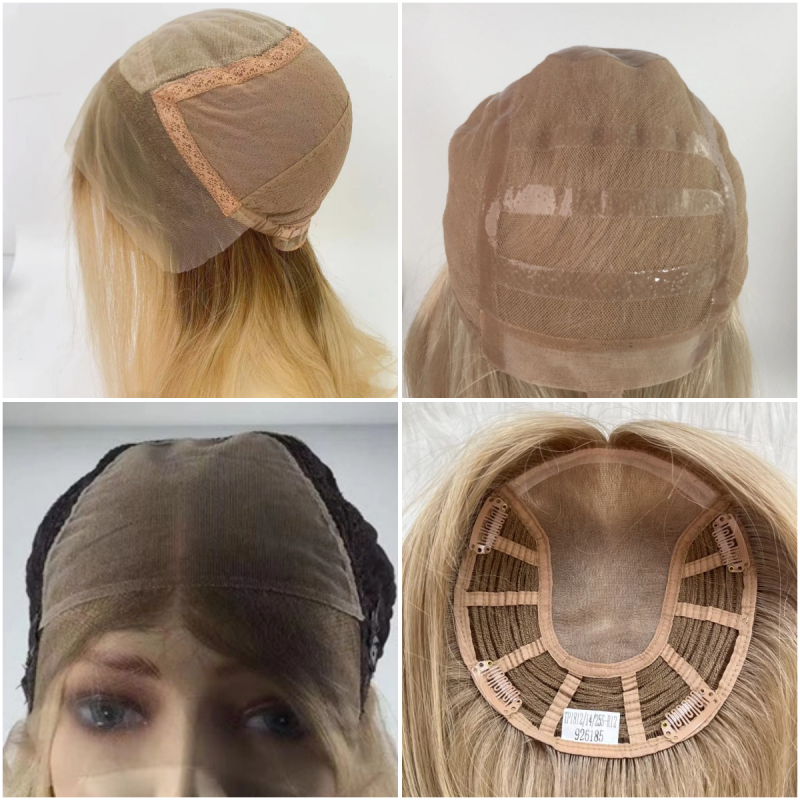
This image shows four different types of wig bases.
The Science Behind the Sizes: Understanding Human Head Variation
The “Average” wig size isn’t arbitrary; it’s based on population-level anthropometric data. According to studies and growth charts from authoritative sources like the U.S. Centers for Disease Control and Prevention (CDC) and the World Health Organization (WHO), the average adult head circumference falls within a predictable range.
For adult women in the United States, the average head circumference is approximately 22 inches (55.9 cm), which aligns perfectly with the “Average” wig size. For adult men, it’s slightly larger, around 22.5 to 23 inches (57.2 to 58.4 cm), often falling into the upper end of “Average” or the lower end of “Large.”
However, it’s crucial to understand that “average” is just a statistical midpoint. A significant portion of the population naturally falls outside this norm. Research shows that head size can vary based on a combination of factors:
- Genetics and Ethnicity: Different populations have distinct average cranial dimensions.
- Age: Head circumference grows rapidly in infancy and childhood, stabilizing in adulthood.
- Body Frame: Individuals with a larger overall body frame often, but not always, have a proportionally larger head.
This natural human variation is precisely why the one-size-fits-all approach fails and why taking your own personal measurements is the only reliable method.
How to Prevent Discomfort While Wearing a Wig for Extended Periods
1. Ensure a Perfect Fit: The Foundation of Comfort
An ill-fitting wig is the primary cause of headaches, pressure sores, and slippage.
- Re-Measure Regularly: Your head size can change due to weight fluctuations, hair loss, or medical treatments. Always re-measure before purchasing a new wig.
- Use Adjustment Straps Correctly: Most wigs come with Velcro or hook-and-loop straps at the nape. Tighten them just enough to prevent slippage without creating pressure.
- Consider a Wig Grip Band: A silicone or fabric grip band worn under the wig creates friction against your skin or bio-hair, preventing the wig from sliding and reducing the need to over-tighten the cap.
Expert Tip: “A wig should feel secure but never constricting. If you feel a ‘headband’ headache within an hour, the fit is wrong.” – Sarah Johnson, Certified Wig Stylist.
2. Choose the Right Cap Construction for Breathability
The internal structure of the wig directly impacts scalp health during long wear.
| Cap Type |
Best For Long Wear? |
Why? |
| Full Lace |
✅ Yes |
Maximum breathability; soft lace conforms to the scalp, reducing hot spots. |
| Hand-Tied |
✅ Yes |
Extremely lightweight and flexible, allowing air circulation. |
| Monofilament |
⚠️ Moderate |
Good breathability at the crown, but the perimeter may be less flexible. |
| Basic Wefted |
❌ No |
Poor ventilation; wefts trap heat and moisture, leading to discomfort. |
3. Prepare Your Scalp and Bio-Hair Properly
What’s underneath your wig is just as important as the wig itself.
- Flatten Your Natural Hair: Secure your bio-hair in flat cornrows or a tight, low bun. This creates a smooth, stable base and prevents lumps that can cause pressure points.
- Use a Soft Liner: A thin, seamless liner made of bamboo or cotton absorbs sweat, protects a sensitive scalp (especially post-chemotherapy), and adds a layer of cushioning.
- Keep Your Scalp Clean and Dry: Wash your scalp regularly to prevent buildup of oils and dead skin, which can lead to itching and irritation under the wig.
4. Manage Heat and Moisture Buildup
Extended wear, especially in warm climates, can lead to a sweaty, itchy scalp.
- Take Breaks: If possible, remove your wig for 10-15 minutes every few hours to let your scalp breathe.
- Use a Portable Fan or Cooling Spray: A small personal fan or a wig-safe cooling spray can provide instant relief.
- Avoid Heavy Adhesives Unnecessarily: For daily wear, strong glues and tapes are often overkill and can trap heat. Reserve them for special occasions or lace-front wigs that require a secure hairline.
5. Maintain Your Wig
A well-maintained wig is a more comfortable wig.
- Clean Regularly: Dirt, oil, and product buildup on the inside of the cap can irritate your skin. Follow the manufacturer’s cleaning instructions.
- Store Properly: Keep your wig on a mannequin head or in a breathable bag to maintain its shape and prevent the cap from becoming misshapen, which can affect fit.
By combining a precise fit, the right cap construction, proper preparation, and good maintenance habits, you can wear your wig comfortably from morning until night without a second thought.
Read this article to learn how to care for your wig: How to care for a human hair wig
Troubleshooting Common Wig Fit Issues: Diagnosis and Practical Solutions
Even with careful measurement and selection, you might encounter fit-related challenges once your wig arrives. Understanding the root cause of these common problems is the first step to a quick and effective fix. Here’s a detailed guide to diagnosing and resolving the most frequent wig-wearing woes.
1. The Wig Feels Too Tight
- Symptoms: Persistent headache, a feeling of pressure around the hairline or temples, visible red marks on the scalp after removal, and the wig’s edges curling upwards.
- Diagnosis: This usually indicates that the cap size is too small for your head. It can also be exacerbated by wearing your bio-hair in a bulky style underneath (like a high bun) or by a cap construction with minimal stretch (e.g., a basic wefted cap).
- Solutions:
- Immediate Relief: Remove the wig immediately to prevent further discomfort or potential traction alopecia.
- Check Your Prep: Ensure your natural hair is flattened tightly against your scalp with braids or a wig cap before trying it on again.
- Verify Measurements: Re-take your head measurements to confirm your size. If you are between sizes, you likely need the larger one.
- Adjustment Limits: For wigs with adjustable straps, make sure they are set to their loosest setting.
- Professional Help: In some cases, a professional wig stylist can carefully stretch the cap using steam, but this is a delicate process best left to experts and isn’t suitable for all cap types (especially lace).
2. The Wig is Too Loose and Slips
- Symptoms: The wig slides backward, shifts from side to side, or feels insecure, especially when you move your head or are in a breeze.
- Diagnosis: The most common cause is a cap that is too large. Other factors include a very smooth scalp (common right after washing your hair), insufficient use of the wig’s built-in adjustment features, or an incompatible head shape (e.g., a very flat back of the head).
- Solutions:
- Use the Adjustment Straps: This is the first and easiest fix. Locate the hooks or Velcro tabs at the nape of the neck and tighten them incrementally until the wig feels secure but not constricting.
- Employ a Wig Grip Band: A silicone or fabric wig grip band is worn directly on your head under the wig. Its primary function is to create friction, preventing the wig from sliding on your skin or hair. This is a highly effective and non-damaging solution.
- Secure Your Bio-Hair: Put your natural hair into tight, flat cornrows or secure it firmly in a net. This creates a stable, textured base for the wig to grip onto.
- Adhesives (For Lace Fronts): If you have a lace front wig, medical-grade wig tape or liquid adhesive applied along the front hairline can provide a strong, secure hold. Always perform a patch test first to check for skin sensitivity and follow proper removal protocols to avoid damaging the lace.
3. The Wig Sits Off-Center or Looks Crooked
- Symptoms: The part is not aligned with your natural part, the bangs hang unevenly, or the entire wig appears tilted to one side.
- Diagnosis: This is almost always a result of improper placement during the initial donning of the wig, not a sizing issue.
- Solutions:
- Find Your Center: Before putting on the wig, identify your true center. You can do this by parting your hair down the middle or simply visualizing a line from the center of your nose to the center of your forehead.
- Align the Front: Hold the wig up to your face and align its front center point (often marked by a label or a slightly different stitch) with your own center point.
- Slide On Carefully: Once aligned, slide the wig straight back over your head without twisting or shifting it. Look in a mirror from the front to double-check its symmetry before making any final adjustments.
4. There’s a Gap at the Nape of the Neck
- Symptoms: The back of the wig doesn’t lie flat against your neck, creating a noticeable space or “bubble.”
- Diagnosis: This typically means your “Nape of Neck” measurement is smaller than the wig’s corresponding dimension, or your head has a more pronounced curve at the back.
- Solutions:
- Tighten the Back: Use the wig’s adjustment straps to their maximum comfortable tightness. This will often pull the excess material in at the nape.
- Add Padding: A simple and effective DIY fix is to sew a small, soft fabric pad (filled with cotton or foam) to the inside of the wig at the nape. This fills the gap and pushes the wig forward into a more natural position.
- Choose a Different Style: Some wig styles, particularly those with a tapered or contoured nape design, are better suited for heads with a flatter back profile.
By understanding these common issues and their solutions, you can transform a frustrating experience into a manageable one, ensuring your wig remains a source of confidence and comfort.
Practical Solutions for a Perfect Fit
Even with the correct size, you may need to make minor adjustments. Most modern wigs come equipped with features to help you achieve a custom fit:
- Adjustment Straps: Located at the nape, these elasticated or hook-and-loop straps can typically tighten or loosen the circumference by up to an inch.
- Silicone Grips or Combs: Many wigs have soft silicone strips along the front and/or perimeter to grip your scalp, or small combs that anchor into your bio-hair for added security.
- Wig Liners and Grip Pads: If you’re between sizes or have a particularly smooth scalp, accessories like wig grips (a thin, stretchy band worn under the wig) or adhesive pads can provide extra hold without damaging your skin or hair.
For those who fall significantly outside the standard size ranges, custom-made wigs are an excellent, albeit more expensive, option. A professional wig maker will take a precise cast or set of measurements of your head to create a cap that fits like a glove.
In conclusion, knowing what size wig to buy is a matter of precision, not guesswork. By understanding the limitations of standard sizing, taking your own detailed measurements, and using the data to consult a comprehensive size chart, you can confidently select a wig that is comfortable, secure, and ready to become a seamless extension of your personal style.
Sizing Considerations for Unique Head Shapes and Special Circumstances
While standard wig sizing charts are designed for the “average” head, many individuals have unique anatomical features or find themselves in specific life situations that require a more nuanced approach to sizing. Ignoring these factors can lead to discomfort, insecurity, or an unnatural look. Here’s how to navigate sizing for some common special cases.
1. For Individuals Experiencing Hair Loss (e.g., Due to Chemotherapy or Alopecia)
- Unique Challenges: The scalp is often extremely sensitive after hair loss, and the absence of natural hair means there’s no cushioning between the wig cap and the skin. Additionally, weight fluctuations during treatment can cause subtle changes in head circumference.
- Sizing Strategy:
- Prioritize Comfort Over Snugness: A wig that is even slightly too tight can cause significant pain or sores on a sensitive scalp. It’s generally safer to choose a size that is at the upper end of your measurement range or even a half-size larger.
- Cap Construction is Key: Opt for the softest, most flexible cap types available, such as full monofilament, hand-tied, or full lace caps. These minimize friction and pressure points.
- Use a Liner: A soft, seamless bamboo or cotton wig liner can add an extra layer of protection and comfort.
- Re-Measure if Needed: If you’ve experienced significant weight gain or loss since your initial measurement, it’s wise to measure again before ordering a new wig.
2. For Those with Non-Standard Head Shapes
- Long or Oval Head Shape: Characterized by a greater distance from the front hairline to the nape than the ear-to-ear width.
- Challenge: A standard “Large” wig might fit the front-to-nape length but be far too wide from ear to ear, causing slippage on the sides.
- Solution: Look for brands that provide detailed measurements for all six key points, not just the circumference. You may need to prioritize the “Front to Nape” measurement and accept that the “Ear to Ear over Top” will be slightly loose, which can be managed with a wig grip band.
- Round or Wide Head Shape: Characterized by a broad ear-to-ear measurement relative to the front-to-nape length.
- Challenge: A standard “Medium” wig might fit the sides perfectly but feel cramped from front to back.
- Solution: Prioritize the “Ear to Ear over Top” and “Circumference” measurements. A cap with a stretchy perimeter and a monofilament top can offer more give in the crown area.
- Flat Back of Head (Occipital Flattening):
- Challenge: This common shape causes a gap between the wig and the nape of the neck, making the wig sit too high or tilt forward.
- Solution: Choose wigs specifically designed with a contoured or tapered nape. As mentioned in troubleshooting, adding a small internal pad at the nape can also effectively solve this issue.
3. For Cosplayers and Theatrical Use
- Unique Challenges: Wigs for cosplay or stage are often much heavier, larger, and more stylized than everyday wigs. They must withstand vigorous movement, long wear times, and sometimes extreme weather conditions.
- Sizing Strategy:
- Security is Paramount: A slightly snugger fit is often preferred to prevent the heavy wig from shifting or falling off during performance. However, it should never be painful.
- Robust Anchoring: Relying solely on the wig’s built-in straps is rarely enough. Use a combination of a strong wig grip band, a well-secured wig cap over tightly braided bio-hair, and multiple U-shaped hairpins or wig clips anchored into a sturdy base (like a wig block or your own braids).
- Consider Customization: For frequently used or very expensive character wigs, investing in a custom-sized cap or having a standard wig professionally altered for a perfect fit is a worthwhile consideration.
By acknowledging and planning for these special circumstances, you can move beyond the limitations of a one-size-fits-all approach and find a wig that fits your unique needs, ensuring both comfort and confidence.
Final Summary: Mastering the Art of the Perfect Wig Fit
Achieving a truly comfortable, secure, and natural-looking wig fit is not a matter of chance—it’s a science rooted in precise measurement, an understanding of human anatomy, and informed choices about construction and care. As we’ve explored, standard sizing charts are merely a starting point; they often fail to account for the beautiful diversity of human head shapes and the unique challenges posed by medical hair loss, theatrical use, or personal style. By mastering the six essential measurements, you create a personal blueprint that transcends generic labels like “Medium” or “Large.” Understanding how different cap constructions—from basic wefts to full lace—interact with these measurements empowers you to select a foundation that prioritizes both comfort and realism. Furthermore, proactive strategies for preventing long-term discomfort and practical solutions for common fit issues ensure your wig remains a source of confidence, not frustration. Ultimately, the perfect fit is a holistic process that blends data-driven selection with personalized care, transforming your wig from a simple accessory into a seamless extension of yourself.
About Emeda Hair: Your Partner in Custom Hair Solutions
Qingdao Emeda Arts & Crafts Co., Ltd. stands as a leading Chinese manufacturer of premium human hair products. Since launching our Emeda brand in 2013, we have dedicated ourselves to creating fashionable, high-quality hair solutions for a global clientele. All our products—including men’s toupees, women’s wigs and toppers, hair extensions, and specialized American and African hair—are crafted exclusively from 100% human hair. Our meticulous production process involves over 56 quality control steps to guarantee exceptional softness, durability, and a natural look. At Emeda, we specialize in custom hair services to meet your unique styling needs, whether you desire voluminous curls, sleek straight locks, or vibrant colors. We proudly support various business models, including wholesale, OEM, and private label partnerships, making us a reliable and versatile partner for your hair product requirements. Contact Emeda today!