Nano bead hair extensions — also called nano rings, nano tips, or nano bonds — are a strand-by-strand, semi-permanent extension method that attaches individual pieces of extension hair to small sections of natural hair using tiny metal or silicone-lined beads, roughly 2 to 3 millimetres in diameter. Unlike tape-ins or keratin bonds, the attachment is mechanical: no heat and no glue touch the natural hair at the root. The bead is threaded with a small section of natural hair, the nano tip is slid alongside it, and the bead is clamped shut with pliers. A full head is not one piece but typically 100 to 200 separate attachments, placed row by row.
That strand-by-strand construction is the single biggest reason nano bead cost behaves differently from other extension methods. Labour dominates the invoice, and reusability changes the long-term math.
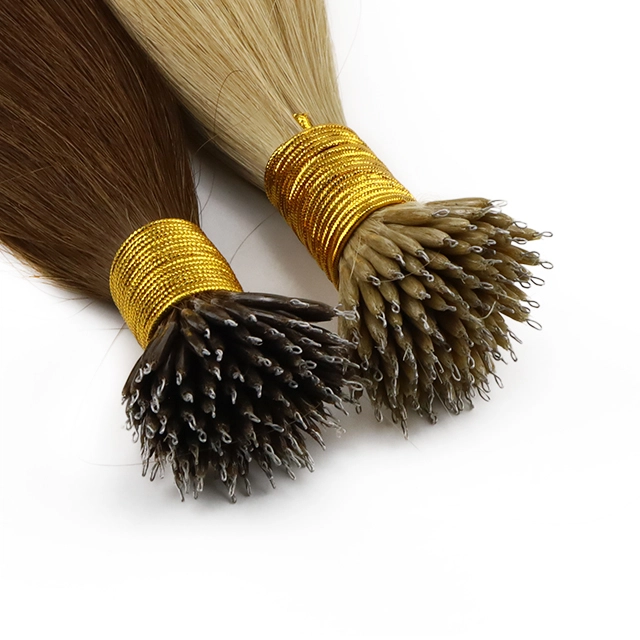
This image shows the condition of the attachment points for nano-ring hair extensions; the structure at the roots is clearly visible.
The defining advantage of nano beads is size. At 2–3 mm, the beads sit flatter and hide more effectively than micro rings (4–5 mm), especially on fine or light-coloured hair. Because there is no adhesive and no thermal bonding, the natural hair at the root is not exposed to glue residue or heat damage in the same way as tape or keratin methods. Cost implication: the gentler attachment does not reduce the hair price, but it lowers the risk premium — the probability of corrective treatments, early removal, or hair-health setbacks that add unplanned cost later.
Nano tips and micro rings are reusable; keratin bonds are not. With proper care, the hair itself can last 6 to 12 months and be reused for up to three applications, meaning the recurring cost is mostly labour and fresh beads rather than a full new set of hair each cycle. This is the most important cost argument in favour of nano beads: the first install is expensive, but the second and third are not.
The table below maps the main specification levers to the practical advantage each one purchases — and how each lever moves the cost.
| Specification / Design lever | Typical range | Advantage purchased | Cost effect |
|---|---|---|---|
| Bead diameter | 2–2.5 mm (nano) vs 3.5–5 mm (micro) | Near-invisible attachment; suitable for fine hair; less root tension per bond | Smaller bead itself does not cost more, but finer placement means more strands and longer fitting time |
| Strand weight per bond | 0.5–0.7 g for fine-hair conservative fits; ~1 g standard | Lighter weight reduces traction risk on delicate roots | Conservative fitting uses more bonds for the same volume → higher labour |
| Length | 14–28 inches common range | Longer lengths create dramatic transformations but require more hair grams and longer fitting | Cost rises with length, but quality moves price more than length does |
| Hair weight per pack | 50 g (light fill) or 100 g (full volume) | 50 g suits volume top-up; 100 g suits full-head density | 100 g packs roughly double hair cost before labour |
| Hair grade | Standard Remy vs double-drawn cuticle-intact Remy | Cuticle-intact hair tangles less, lasts longer, and tolerates reuse | Higher upfront, but fewer replacements over 12 months — the lower total-ownership choice |
| Strand count per pack | 20, 25, 50, or 100 strands depending on brand | More strands per pack means fewer packs to buy for a full head | Compare cost per strand, not pack price alone |
| Installation method (salon pricing basis) | Flat fee, per-hour, or per-pack add-on | Flat fee protects against overtime; per-pack pricing rewards bringing your own hair |
A nano bead invoice is really two purchases stitched together: the hair itself and the labour to fit it strand by strand. Good-quality human hair for nano work commonly lands between roughly $60 and $180 per 100 grams at wholesale or salon rates in comparable markets, with double-drawn Remy sitting at the top of that range. Labour is where nano beads separate from wefts and tapes: because each bead is applied one at a time, a full-head fitting can stretch past three hours, and salons price that time as a flat install fee, an hourly rate, or a per-pack charge.
Industry averages for installation labour alone put nano beads at $450 to $1,200, above micro-links ($300–$900) and tape-in installs ($250–$600), reflecting the precision and time required.
The final figure depends less on the salon’s postcode than on hair quality and strand count. In practice, three tiers emerge:
Light volume touch (one to two packs): $400–$700 all-in.
Three-quarter head (noticeable length and thickness): $900–$1,600.
Full head, premium double-drawn hair, longer fitting: $1,800–$2,600.
Across broader market guides, total salon packages commonly fall in the $600–$2,000+ range, with hair alone at $90–$500+ and professional installation at $300–$800+.
The larger hidden cost is aftercare products — but the bigger hidden saving is reusability. Maintenance appointments run every 6 to 8 weeks at $100–$250 per visit, and removal or re-hair processing adds $50–$150+. If the hair is reused for three cycles, the cost per wear drops substantially compared with a method that cannot be reused. The searcher comparing a $1,200 nano install against a $600 tape-in should ask: what does the second and third fitting cost, and how much hair has to be repurchased? That is where the nano bead cost argument actually lands.
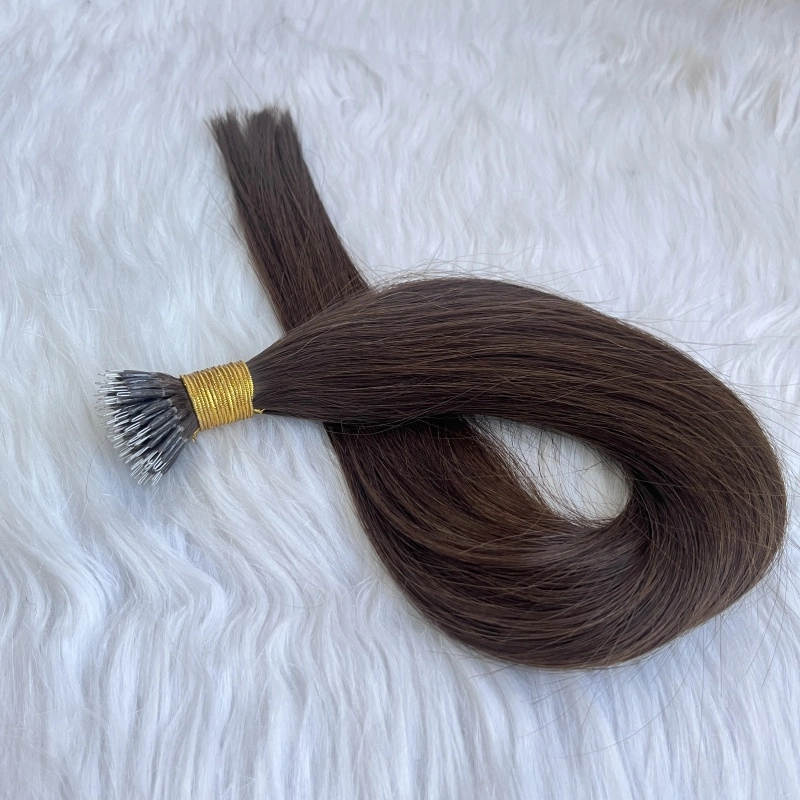
This image shows the nano hair extensions folded over, revealing their flexibility and smoothness.
Nano beads are the go-to for fine hair and maximum discretion. For someone who wants 20–22 inches of everyday length without clipping pieces in and out, nano extensions can be the more sustainable option — provided the wearer commits to the maintenance schedule. The higher upfront labour is amortised over daily wear, not saved for occasional events.
Nano bead extensions are repeatedly positioned as suitable for weddings, dances, parties, and photoshoots because the attachment is nearly invisible and the hair moves naturally. For a one-off event, nano beads are rarely the cheapest route; the cost logic works best when the install is booked with the intention of wearing it through the season, not removed the next morning.
Because the beads sit flat and hide under most styles, nano beads fit office settings and weekend outings without obvious hardware. The cost case here is low visual profile plus low daily styling time — the wearer is not spending extra minutes hiding clips or adjusting tapes.
Nano bead extensions are marketed as lifestyle-friendly for active wearers, but the qualifier matters: they are low-maintenance only relative to clip-ins and tapes, and not maintenance-free. The cost of skipping maintenance is not just inconvenience; past the 8-week mark, salons may add $25–$100 in extra detangling fees, and tension-related breakage can turn a reusable set into a write-off.
Human hair nano extensions can be coloured, heat-styled, and permed (with light-to-dark dyeing recommended), and the strand-by-strand format allows colour blending across multiple tones. For a wearer who changes length or colour seasonally, the reusability of the hair makes the cost-per-experiment lower than methods that cannot be recoloured or reused.
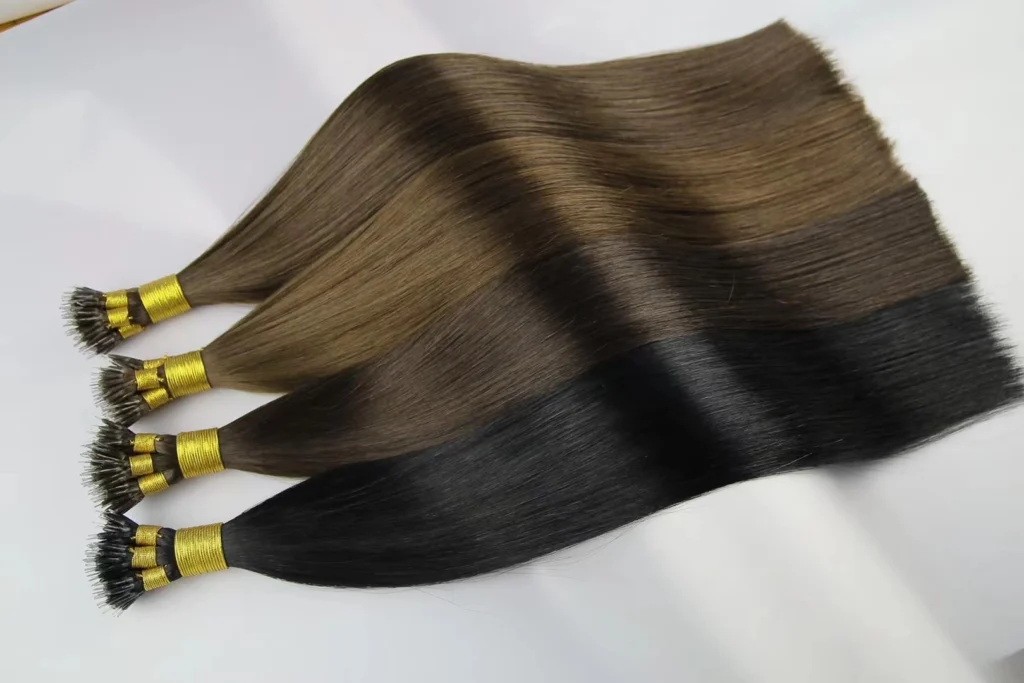
This image shows Nano hair extensions in four different colors, all of which belong to the dark-toned range.
Nano beads suit healthy fine hair, not damaged or brittle hair. A consultation should check strand elasticity (does hair stretch and spring back, or snap?), scalp health, density across the whole head, and recent chemical services. Skipping this step is the most expensive mistake available: fitting nano beads onto compromised hair can cause traction damage and turn a reusable investment into a removal-and-repair bill.
After installation, avoid washing the hair for 24–48 hours to allow the beads to settle and the attachment to stabilise. This is a low-cost step with a high cost-avoidance value: premature washing can loosen beads and require early repositioning.
Recommendations consistently point to washing no more than twice a week and using sulfate-free, extension-safe shampoo and conditioner. Sulfates can swell or loosen the beads prematurely; overwashing dries the extension hair and shortens its reusable life. Shampoo twice — once to remove product, once to clean — and follow with a moisturising mask on the mid-lengths and ends, not at the root.
Use a loop brush or extension brush and work from the ends upward, not from the root down. A wide-tooth comb is the minimum; a loop brush is the tool that prevents the bead area from being dragged. This is the daily habit that protects both the natural hair and the extension strand from unnecessary breakage.
Nano tips tolerate heat, but constant high heat near the beads can shorten the lifespan of the attachment and the hair. Keep styling tools on a safe setting — below 180°C — and apply a heat protectant before any hot tool touches the extension hair. Heat damage is one of the fastest ways to turn a reusable set into a single-cycle purchase.
Going to bed with wet hair is a direct route to tangling and matting at the root, especially where beads create small anchor points. Ensure the extensions are completely dry before sleeping. This step costs nothing and protects the most expensive part of the system — the strand attachments.
Maintenance is essential, not optional, on nano beads. Move-ups are recommended every 6 to 8 weeks (some sources say 5 to 8 weeks depending on hair growth and bead type). Past 8 weeks, salons may charge extra for detangling, and the risk of tension damage and matting rises sharply. Budgeting the move-up as a fixed line item — $100–$250 per visit — is the only realistic way to compare nano bead cost against methods with lower maintenance frequency but no reusability.
Bottom line on nano bead hair extensions cost: the method is not the cheapest way to add hair for a single event, and it is not the lowest upfront number on a salon menu. The cost argument becomes compelling when the wearer plans to reuse the hair, commits to the 6–8 week maintenance cycle, and values near-invisible attachment on fine hair. For that wearer, the higher first invoice is a down payment on a lower cost per wear — and the specification table above shows exactly which lever to pull to keep that calculation in your favour.
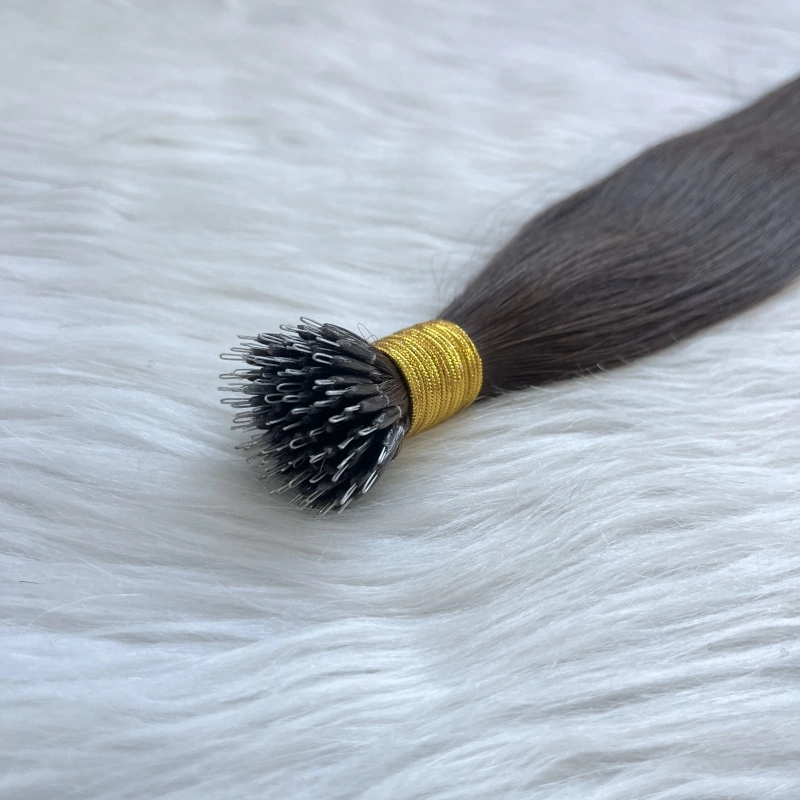
This image also focuses on the root area of the nano hair extensions.
Nano bead hair extensions are a strand-by-strand, semi-permanent method that uses tiny beads of roughly 2–3 mm to attach extension hair to natural hair without glue or heat. For anyone searching “nano bead hair extensions cost,” the real question is not a single sticker price but the total cost of ownership: hair, installation labour, maintenance, and reusability.
Key cost drivers and advantages
Discreet, glue-free, heat-free attachment: the small bead size suits fine hair and reduces the risk of root damage and corrective costs.
Reusability changes the long-term math: quality hair can last 6–12 months and be reused for up to three applications, so later fittings cost mainly labour and fresh beads rather than a full new set of hair.
Specifications move the price: bead diameter, strand weight, length, pack weight, hair grade, strand count, and salon pricing method all affect the final invoice. Compare cost per strand and total strand count, not pack price alone.
Realistic budget tiers:
Light volume touch: about $400–$700 all-in
Three-quarter head: about $900–$1,600
Full head with premium double-drawn Remy hair: about $1,800–$2,600
Broader market packages commonly fall in the $600–$2,000+ range, with installation labour alone at about $450–$1,200.
Where the cost makes sense
Nano beads work best for fine-haired clients who want maximum discretion, daily “set-and-forget” wear, weddings and events, office and low-profile styling, active lifestyles with a maintenance commitment, and wearers who want to experiment with length or colour. They are rarely the cheapest option for a one-off event, but when the hair is reused and maintenance is kept on schedule, the cost per wear becomes more competitive.
Correct use and maintenance
Get a professional suitability assessment before booking — check hair elasticity, scalp health, density, and recent chemical services.
Avoid washing for 24–48 hours after installation so the beads can settle.
Wash no more than twice a week with sulfate-free, extension-safe products.
Detangle from the ends upward with a loop brush or extension brush.
Keep high heat away from the bead zone — keep styling tools below about 180°C and use heat protection.
Never sleep on wet hair, which can cause tangling and matting at the root.
Book move-ups every 6–8 weeks at about $100–$250 per visit; delaying maintenance can add detangling fees and raise the risk of tension damage.
Bottom line
Nano bead hair extensions are not the cheapest one-off option, but for fine-haired wearers who want a discreet, natural result, will commit to 6–8 week maintenance, and plan to reuse the hair, the higher upfront cost can translate into a lower cost per wear. Whether they are “worth it” depends on hair grade, total strand count, installation labour, maintenance frequency, and — most importantly — whether the hair can be reused.
Dont hesitate to Contact EMEDA Hair Factory:
 WhatsApp: +8618562611116
Email: sales02@emedahair.com